
_
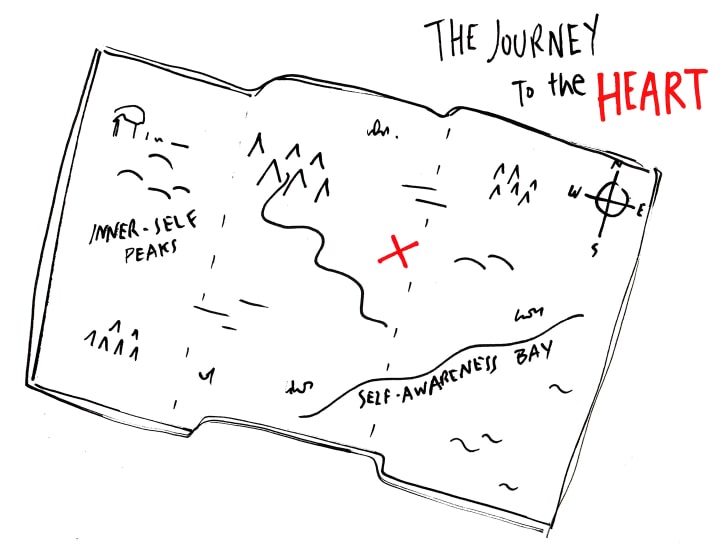
Reflections on conflict, the inner critic, and the journey to the heart.
Over the last few weeks I have been reflecting deeply on conflict.
Conflict as the energy of hurt in the heart.
Conflict as wound.
Conflict as pain.
Conflict as a bundle of high emotional energy that both covers and points toward what is important to us.
Toward what our needs are.
Conflict as information.
Conflict as creative energy.
Curious about the word itself, I looked up conflict in the dictionary. It is defined as a clash, a serious disagreement or argument typically lasting for a long time.
Yet the more I observe my own conflicts, the more I realise that they often originate somewhere else.

_
The conflict within
As I began examining the conflicts in my life, something unexpected appeared.
Many of them seem to derive from a deeper one:
the conflict with myself.
Not loving myself enough.
Not recognising my own worth.
Expecting from others what I may not yet be giving myself.
In a way, not taking full responsibility for my own needs.
Looking into conflict requires time and courage.
It also requires something else: support.
Being part of The Mighty Heart community, guided by peacebuilder Scilla Elworthy, has provided exactly that.
I felt held. Deeply grateful for it.

_
Listing the conflicts
As part of this exploration, I began listing the conflicts that have accompanied me along the journey of life.
Some are old unresolved tensions with friends who are no longer close.
Some are unspoken tensions within family relationships.
Others are small everyday frictions that arise and dissolve as life moves one.
There are also conflicts I am not yet ready to open.
And I am learning that before entering those conversations with others, something else is needed first.
A conversation with myself.
Or rather, many conversations.
Conversations that allow clarity to emerge in the first person — I — without pointing fingers.
Taking responsibility for my conflicts begins with taking responsibility for myself.

_
Phantom feelings
As I observed more closely, I noticed familiar inner narratives:
I feel unseen.
I feel unrecognised.
I feel too much in service of others and too little supported.
I feel unheard.
Yet when I slow down and sense these feelings with a fuller, calmer heart, something shifts.
Because the truth is:
I am seen.
I am recognised.
I am supported.
I am heard.
In that moment I wrote a sentence to myself in my journal:
Do not expect. Express.
Do not expect others to read what has not been spoken.
Express what you need — when you need it.

_
Conflict as information
What I am beginning to understand is that conflict often arises from unexpressed needs.
Or from needs that have not been heard.
Conflicts are frequently missed conversations.
Of course, conflict can also arise from abuse of power or from boundaries that have been violated. That reality must not be ignored.
But many conflicts are far more subtle.
They are misunderstandings.
And misunderstandings can often dissolve through deep listening.
This insight is central to the peacebuilding work of Scilla Elworthy, who reminds us that many conflicts are ultimately perception errors or perceived incompatibility.

_
What breaks your heart?
In our fist session at The Mighty Heart, Scilla asked a simple yet powerful question:
What breaks your heart?
She invited us to move calmly toward the pain — to inquire into it and to meet the energy behind it.
Because what breaks your heart is often pointing toward something deeply meaningful.
Toward what moves you.
Toward what matters most.
Toward what you might call your soul purpose.
Understanding what breaks your heart may also be a step toward reconnecting with the power of the heart itself.
Yeah 🔥
The one beating quietly in the center of your chest.
_
_
Heartbreak as a key
What feels most painful may actually be the lock that opens your heart.
The energy of heartbreak can release the creative energy needed for change.
There is a strength that becomes available when the heart opens.
And perhaps this is why the question matters most: What breaks your heart?
_

_
Meeting the inner critic
As I continued exploring, I began to sense a connection between my inner conflicts and my inner critics.
It is as if they share the same seeds.
The inner critic,
indeed another source of tension.
At first I noticed how relentlessly I argued with this voice inside myself.
Fighting it.
Resisting it.
Trying to silence it.
I observed, my inner critic is often the voice of fear.
Fear of failure.
Fear of ridicule.
Fear of not being enough.
I noticed how it constantly evaluates and judges: good, bad, better, worse.
It measures risk.
It anticipates danger.
It tries to prevent humiliation, failure, or rejection.
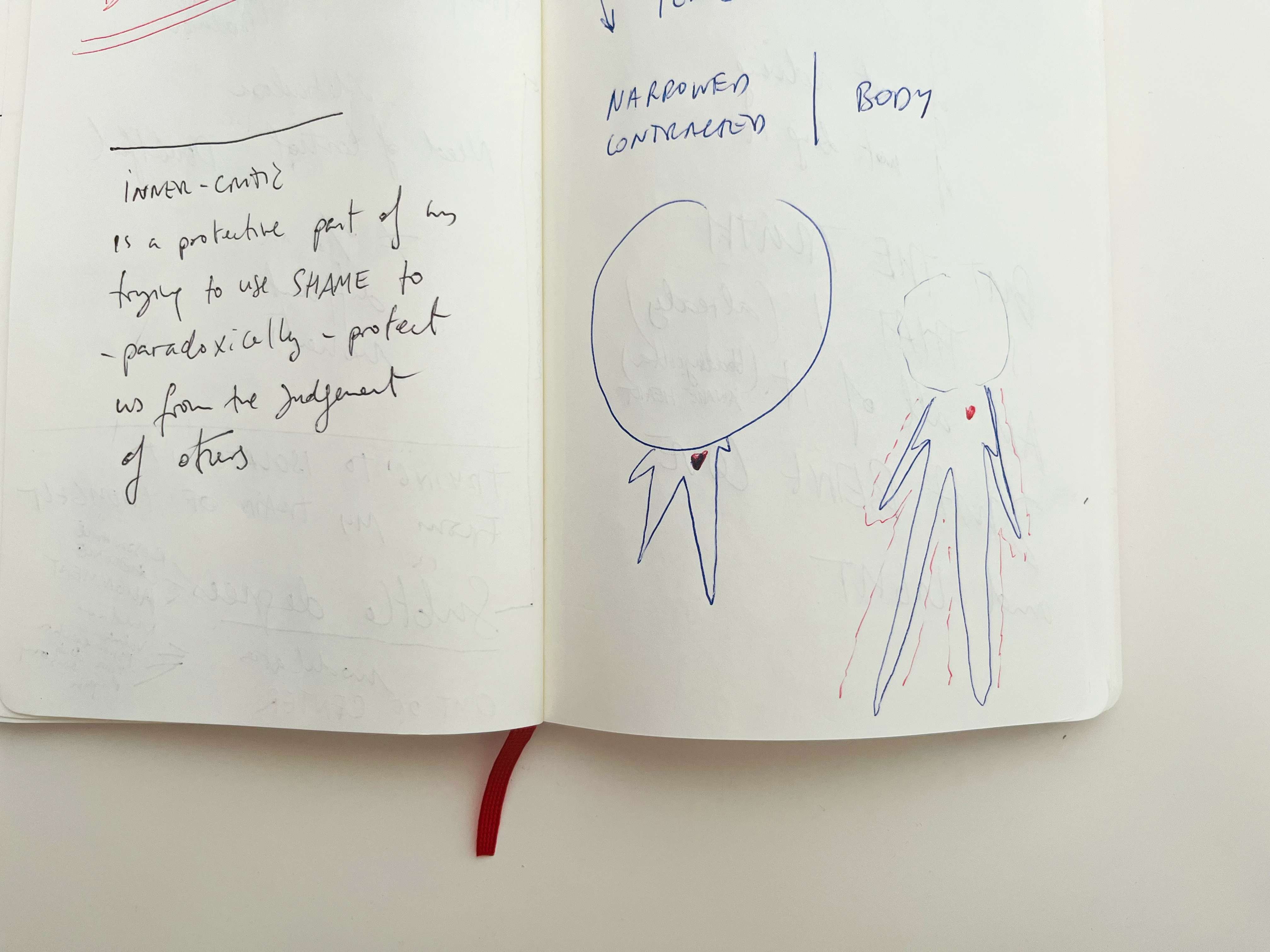
This too translates at the level of the body.
A state of alertness lives within me – sometimes mild, sometimes stronger.
My posture gets narrow, contracted, tense.
There is also a sense of heaviness.
My breath becomes shallow.
My attention rushes upward into my head.
At times it feels as if I have an enormous head and a very small body.
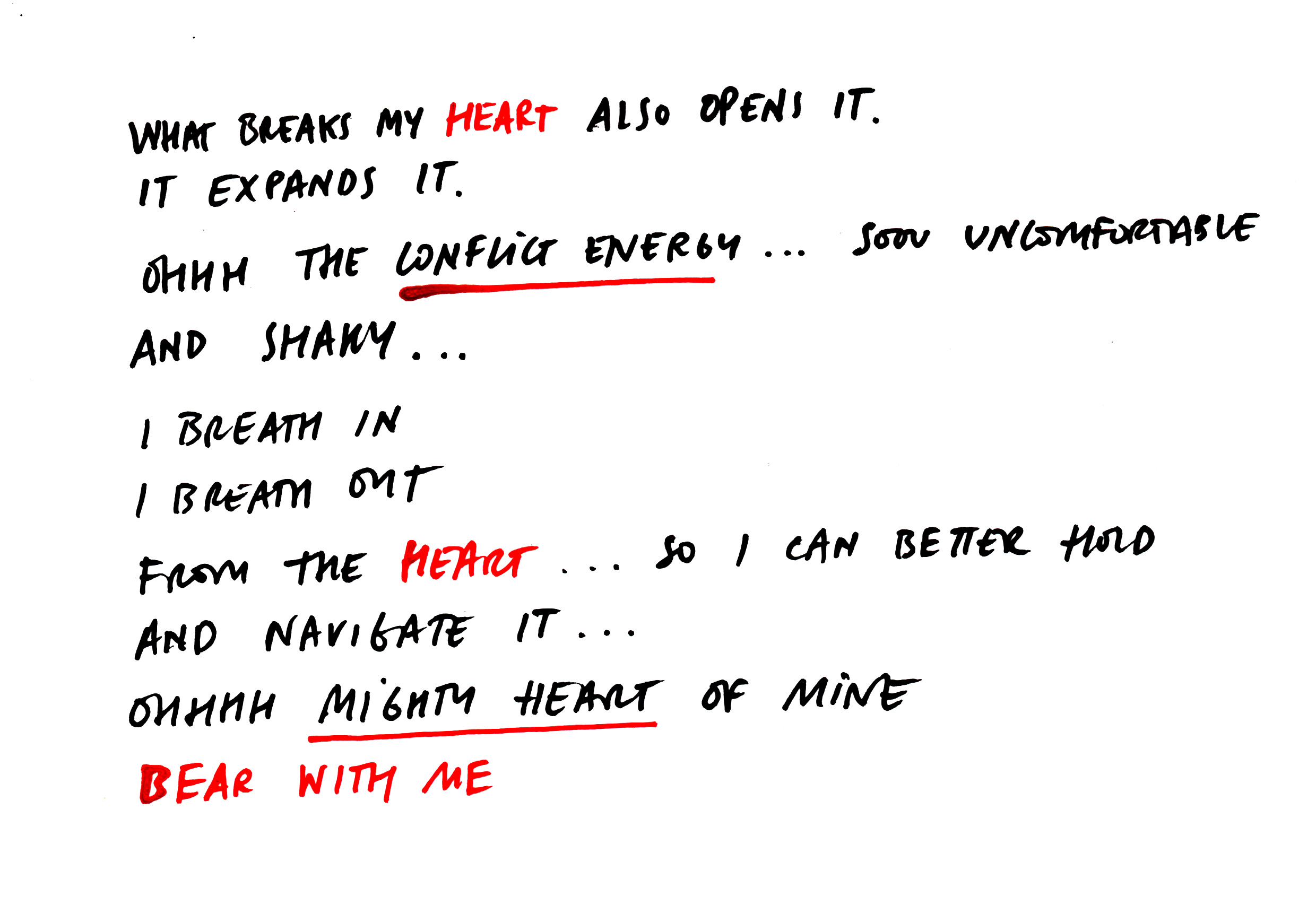
Yet when I intentionally bring my awareness back to my heart — when I pause and breathe from there — something shifts.
My body softens.
My breath deepens.
I expand again.
As I continued listening, anchored in my heart, I also realised something unexpected.
The inner critic was not trying to destroy me.
It was trying — in its own distorted way — to protect me.
_
Listening to the critic
Through practices inspired by the work of Richard C. Schwartz and the Internal Family Systems approach, we were invited to listen to our inner critics.
Not to silence them.
Not to defeat them.
But to understand them..
The more I listen, the more I grasp…
My inner critics may actually love me more than they know how to express.
Her language is shaped by fear, by judgment, by worry — yet underneath there is a genuine desire to protect what matters.
There is signal underneath the interference.
The voice of the inner critic may sound harsh, distorted, or overwhelming — yet beneath that interference there is often valuable information waiting to be unveiled.
There is valuable information hidden in the noise.
In listening more deeply, I discovered that one of my inner critics was extremely responsible, diligent, and attentive.
She was deeply afraid of failure.
Underneath that fear, another message appeared:
There is opportunity here.
There is potential.
This matters.
Our conversation slowly changed the relationship.
Instead of working against me, she could begin working with me.
What once felt like an inner enemy is becoming something else: a watchful ally.
_
The sword of discernment
The word critic itself carries an interesting origin.
The Greek word kritikos means to discern — to sort out what is useful from what is not.
A healthy critic is not a voice of condemnation.
It is a voice of discernment.
Psychological researchers and Jungian analysts Deborah Stewart, Joseph Lee, and Lisa Marchiano note that a balanced inner critic helps us ask important questions:
Is it true?
In what context?
To what degree?
Discernment is not judgment.
Judgment condemns.
Discernment clarifies.
And clarity is what allows us to move forward wisely.
 _
_
Fear and the culture of performance
There is a widespread belief that the inner critic is necessary for performance.
That the harsh voice inside us pushes us to try harder, do better, and achieve more.
But this belief mirrors an old leadership paradigm.
For a long time, organisations assumed that productivity was driven by fear, pressure, and tension.
Fear was used as a management tool.
Yet decades of research in leadership and organisational psychology show something different.
The deepest drivers of excellence are:
meaning,
purpose,
connection,
and love for the work.
Perhaps the way we relate to our inner critic reflects the same cultural pattern.
A culture of fear outside often mirrors a culture of fear within.
Listening with the heart
What I am learning is that inner critics are often misunderstandings within ourselves.
They are voices shaped by accumulated fears.
Voices that learned to speak through shame and judgment.
Like a little child having a meltdown while we are not paying attention.
That is why the voice grows louder and angrier — moving from being peeved to disappointed, furious, anxious, irritated, concerned, and enraged.
But when we meet them with curiosity, patience, and compassion, something shifts.
The noise begins to soften.
And the signal begins to emerge.
Listening becomes the most powerful tool.
Listening to others.
Listening to ourselves.
Listening to what lies beneath the interference.
Now I understand that my inner critic is desperately looking for love.
As I continued listening, I realised something surprising… The inner critic was not trying to destroy me.
It was trying — in its own distorted way — to protect me.
The practice of the heart
This exploration has connected me with the teachings from Chögyam Trungpa and the Shambhala tradition.
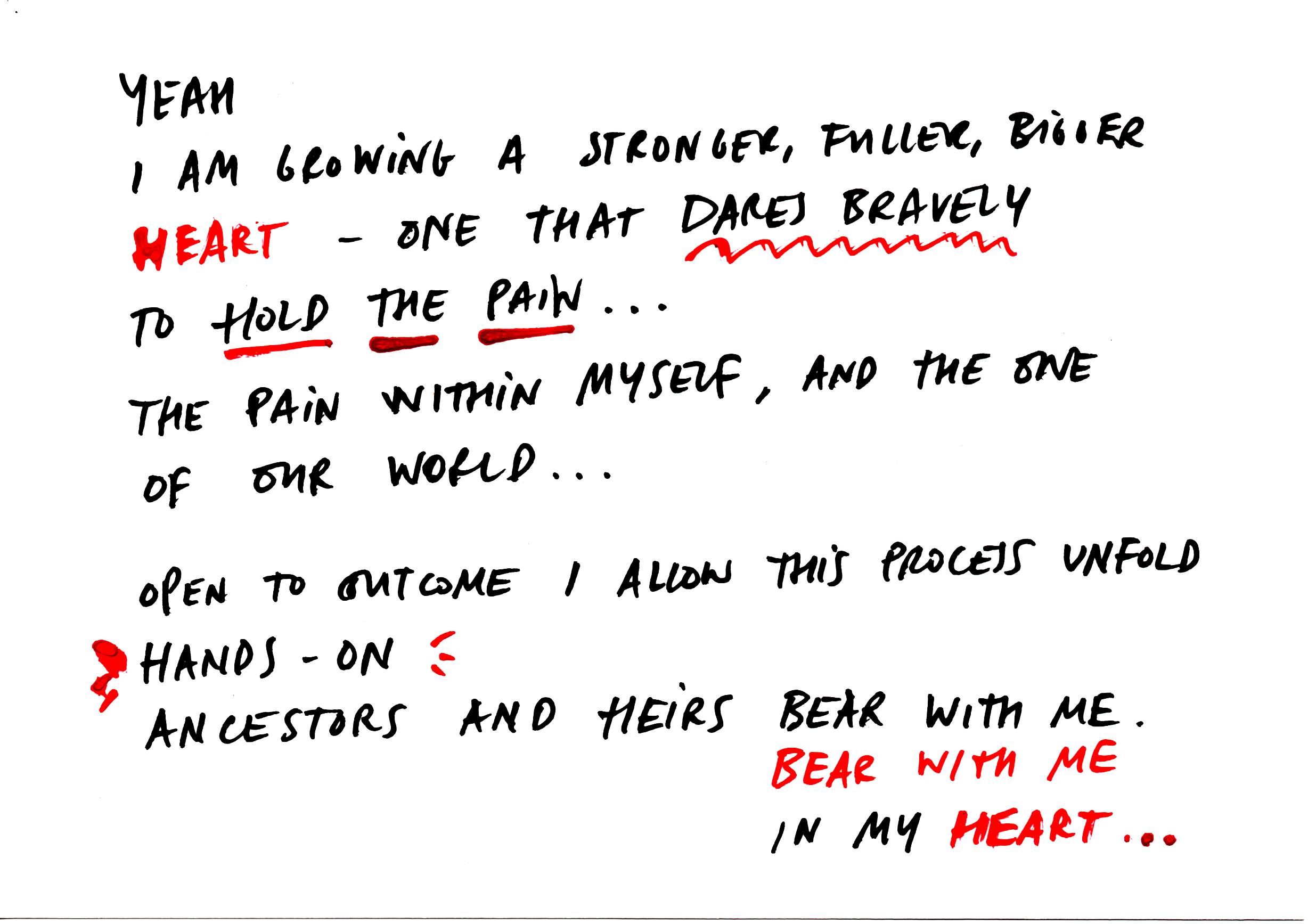
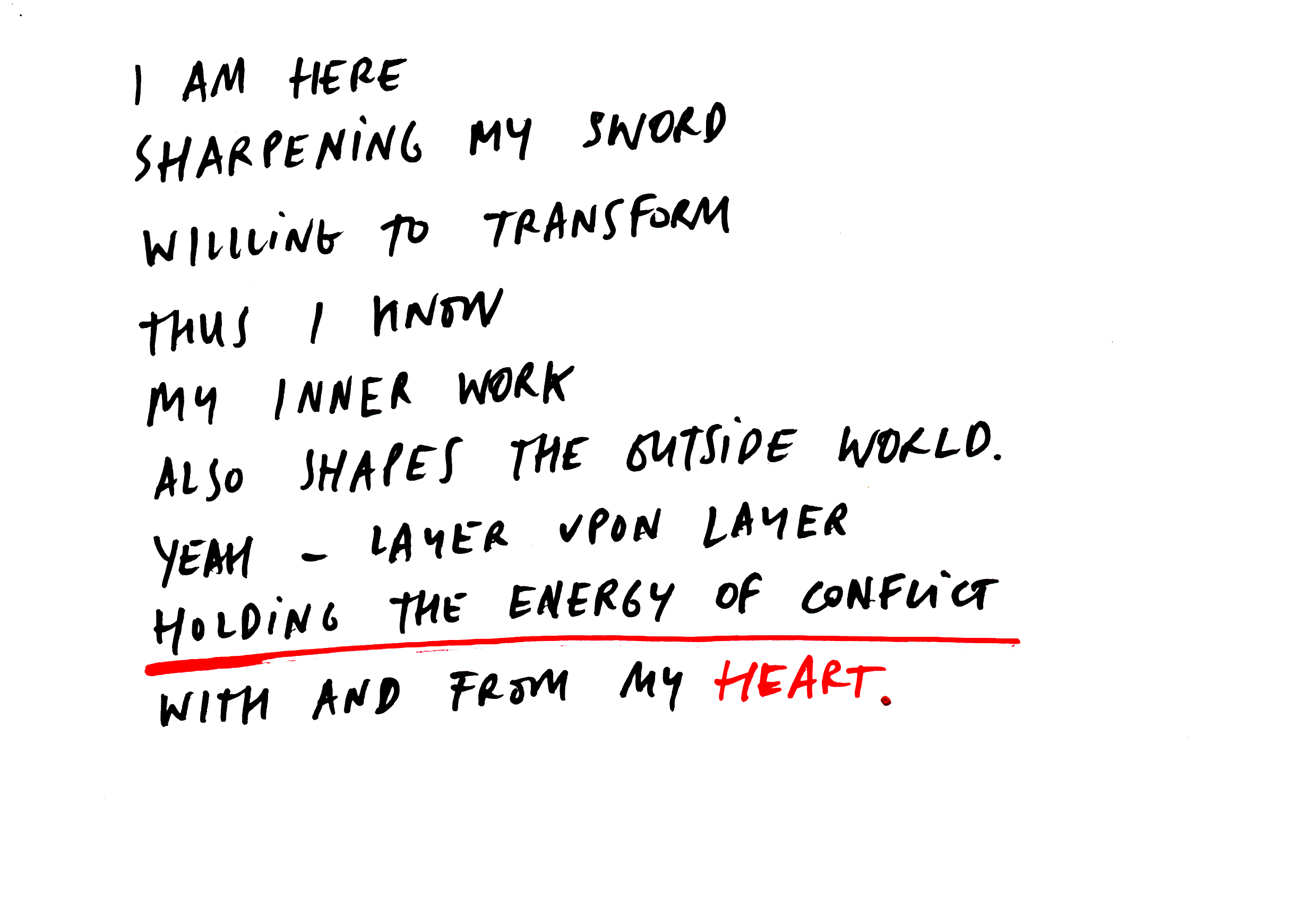
I am sharpening my sword — not a weapon against the world, but a tool for discernment and courage.
A practice of becoming what the Shambhala teachings call a warrior of the heart.
At the core of our being there is what is called basic goodness.
An inherent dignity.
An awakened heart — bodhicitta. In Sanskrit: bodhi – awakened/enlightened; citta – mind in the heart.
The practice is not about becoming someone else.
It is about remembering who we already are.
Learning to trust that basic goodness.
And allowing it to shine from the inside out.
When I hear the voice of the inner critic now saying:
“Nothing you do is good enough.”
I pause.
And I respond differently:
I am good enough.
Not as self-complacency.
But as an act of deep self-love.
An act of wisdom and remembrance.
Every time I hear the inner critic speak, it is a chance — an opportunity — to strengthen the heart muscle of the light warrior that lives within me.

From inner critic to inner coach
My inner critics are slowly transforming.
Not disappearing.
But evolving.
They are becoming something closer to inner coaches.
Voices that remind me to practice:
presence,
breathing,
self-awareness,
love.
When the critical voice appears, I ask a different question now:
What is needed here to love myself more?
Perhaps rest.
Perhaps trust.
Perhaps a deeper breath.
Perhaps simply a smile.
These inner conversations are not about silencing parts of myself.
They are about restoring wholeness — allowing misunderstood voices to be heard, understood, and gently transformed through self-compassion and love.
Remember:
Inner critics are often misunderstandings within ourselves that become wise when met with strength, curiosity, and compassionate listening.

_
The journey to the heart
Leadership from the heart begins inside.
It begins with the way we listen to ourselves.
With the way we hold our fears.
With the courage to meet our inner conflicts with compassion instead of war.
Inner critics, when met with love and curiosity, become teachers.
They point toward the places where healing, clarity, and courage are needed most.
And perhaps this is the deeper lesson.
Conflict — whether within or between us — is not only something to resolve.
It is something to listen to.
Because within the tension lies information.
Within the wound lies wisdom.
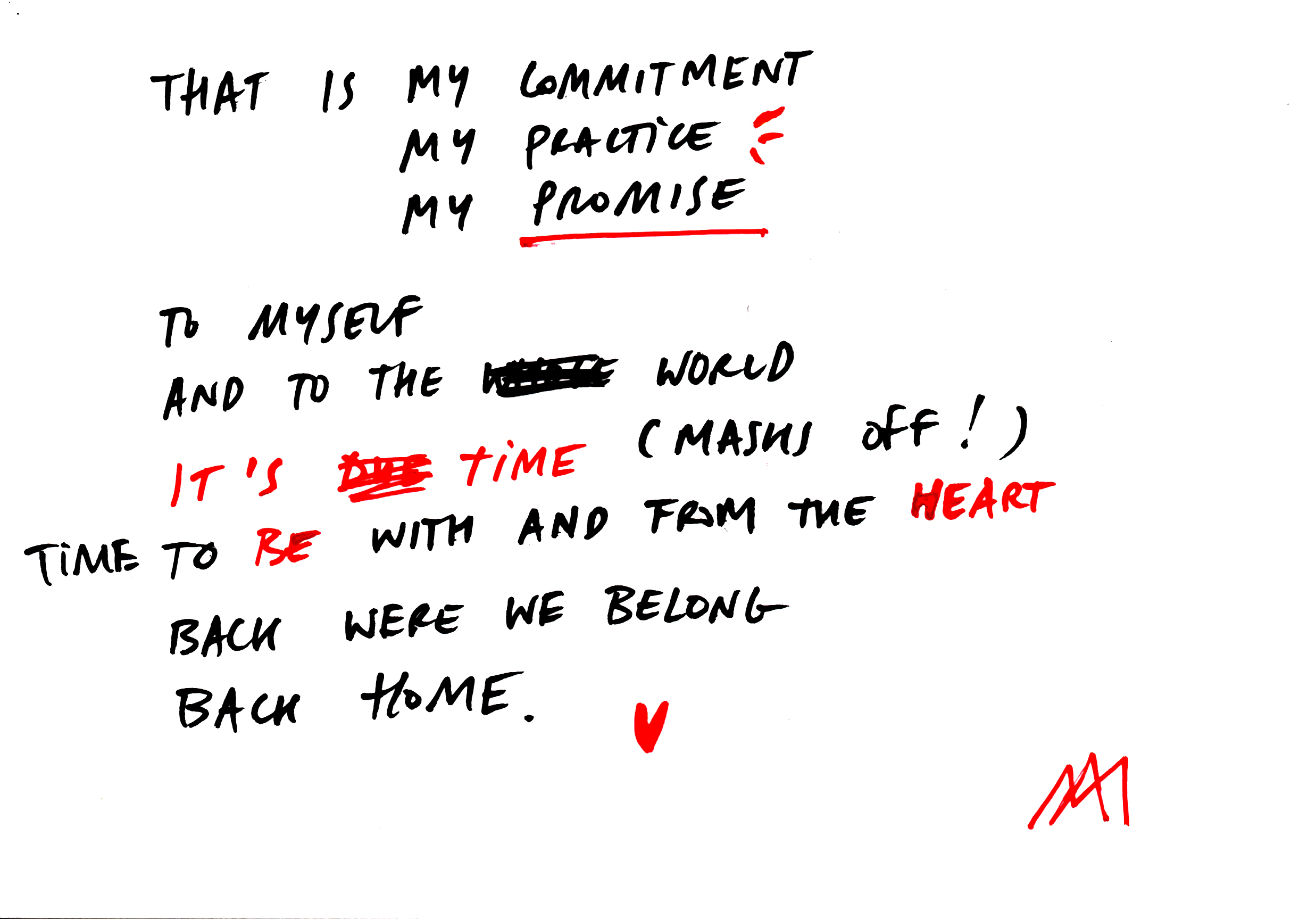
Within the broken heart lies the doorway to transformation — toward a better, brighter, and more peaceful world.
I leave you with the same question that started this exploration.
What breaks your heart?
Because peace in the world begins with the way we relate to conflict within ourselves.
Because what breaks your heart may also be pointing you toward what matters most to you.
Toward the life you are meant to live.
Toward your soul purpose.
Toward the contribution your heart is aspiring to make and the world you are dreaming to create.
Power to you ⚡